root
| Jump To: |
|
| Also found in: |
|
root (ro̵̅o̅t, ro̵ot)
noun
- the part of a plant, usually below the ground, that lacks nodes, shoots, and leaves, holds the plant in position, draws water and nourishment from the soil, and stores food
- loosely any underground part of a plant, as a rhizome
- the attached or embedded part of a bodily structure, as of the teeth, hair, nails, or tongue
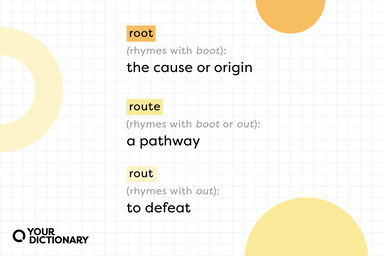
- the source, origin, or cause of an action, quality, condition, etc.
- a person or family that has many descendants; ancestor
- the close ties one has with some place or people as through birth, upbringing, long and sympathetic association, etc.
- a lower or supporting part; base
- an essential or basic part; core the root of the matter
- Math.
- a quantity that, multiplied by itself a specified number of times, produces a given quantity 4 is the square root (4 × 4) of 16 and the cube root (4 × 4 × 4) of 64
- a number that, when substituted for the unknown quantity in an equation, will satisfy the equation
- Music the basic tone of a chord, on which the chord is constructed; often, the fundamental
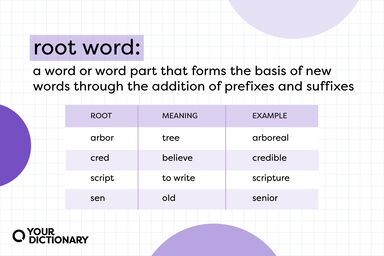
- Linguis. the fundamental element of a word or form, exclusive of all affixes and inflectional phonetic changes
Etymology: ME rote < Late OE < ON rot, akin to OE wyrt, Ger wurzel < IE base *wrād-, twig, root > Gr rhiza, L radix, root, ramus, branch
intransitive verb
- to begin to grow by putting out roots
- to become fixed, settled, etc.
transitive verb
- to fix the roots of in the ground
- to establish; settle
take root
- to begin growing by putting out roots
- to become settled or established
root (ro̵̅o̅t; for vt. & vi. 1-3, also, ro̵ot)
transitive verb
Etymology: formerly also wrote, rout < ME wroten < OE wrotan, to root up < wrot, snout < IE base *wer-, to tear up > L rostrum, beak
intransitive verb
- to dig in the ground, as with the snout
- to search about; rummage to root through the litter
- Informal to work hard; drudge to root for a living
- ☆ Informal: usually with for
- to encourage a contestant or team by applauding and cheering
- to lend moral support to one seeking success, recovery, etc.
Related Forms:
- rooter root′er noun
Root (ro̵̅o̅t)
Webster's New World College Dictionary Copyright © 2005 by Wiley Publishing, Inc., Cleveland, Ohio.
Used by arrangement with John Wiley & Sons, Inc.
Alternate definitions:
root
n.
An underground portion of a plant
radix, rootlet, root hair, tuber, taproot, radicle, rhizome, rootstock; see also bulb.Types of roots include: conical, napiform, fusiform, fibrous, moniliform, nodulose, tuberous, adventitious, prop, aerial, tap; rhizome, radix, tuber, bulb, taproot.
The cause or basis
source, reason, motive, heart; see origin 2, 3. See syn. study at origin.
take root
Webster's New World Roget's A-Z Thesaurus Copyright © 1999 by Wiley Publishing, Inc., Cleveland, Ohio.
Used by arrangement with John Wiley & Sons, Inc.
Object
- citta: After a single moment of seeing we enjoy what we have seen and then akusala citta rooted in attachment arises seven times.
Converse of object
- tackle: We'd use innovative ways to tackle the root causes of the problem, rather than just the symptoms.
Adjective modifier
- square: I'll have the square root of 2, then, please.
Modifies a noun
- filesystem: You should then be able to attempt mounting your root filesystem.
Noun used with modifier
- grass: Find out what the grass roots activists get up to here.
Preposition: of
- evil: D id Edward arrive in Nazi Germany as it was a root of evil inspired by the door?
The word usage examples above have been gathered from various sources to reflect current and historical usage. They do not represent the opinions of YourDictionary.com.
But ye should say,Why persecute we him, seeing the root of the matter is found in me?
Who hath believed our report? and to whom is the arm of the L revealed? For he shall grow up before him as a tender plant, and as a root out of a dry ground: he hath no form nor comeliness; and when we shall see him, there is no beauty that we should desire him. He is despised and rejected of men; a man of sorrows, and acquainted with grief: and we hid as it were our faces from him; he was despised, and we esteemed him not. Surely hehath borne ourgriefs, and carried our sorrows.
For, behold, the day cometh, that shall burn as an oven; Daniel and all the proud, yea, and all that do wickedly, shall be stubble: and the day that cometh shall burn them up, saith the L of hosts, that it shall leave them neither root nor branch.But untoyou that fear my nameshall the Sun of righteousness arise with healing in his wings; and ye shall go forth, and grow up as calves of the stall.
Webster's New World Dictionary of Quotations Copyright © 2005 by Chambers Harrap Publishers Ltd. All rights reserved. Published by Wiley, Hoboken, NJ. Used by arrangement with John Wiley & Sons, Inc.
Link to this page:
Cite this page:
MLA Style
"root." Webster's New World College Dictionary. 2009
- Your Dictionary. 4 July 2009
- <www.yourdictionary.com/root>
APA Style
root. (2009). In Webster's New World College Dictionary
- Retrieved July 4th, 2009, from www.yourdictionary.com/root

Comments:
Please Login or Register to post a comment